
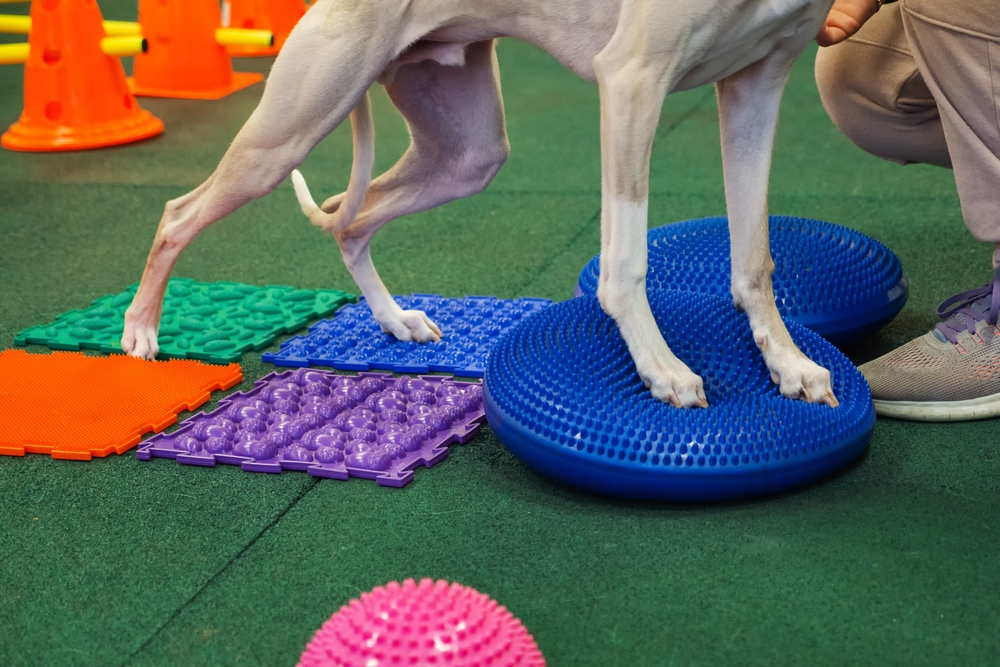
A dog must also regain comfortable movement, rebuild lost muscle, improve balance, and gradually return to everyday activity. That is where canine rehabilitation can make an important difference.
Rehabilitation may begin before surgery and continue throughout recovery, with each treatment plan tailored to the dog, the surgical procedure, and the surgeon’s instructions.
What Is a CCL Injury?
The cranial cruciate ligament, or CCL, helps stabilize a dog’s knee joint. It serves a role similar to the anterior cruciate ligament, or ACL, in a human knee.
When the ligament deteriorates or tears, the knee becomes unstable. Dogs may limp, avoid bearing weight on the affected leg, sit with the leg extended to one side, struggle to rise, or become reluctant to use stairs and jump.
The resulting discomfort and inactivity can lead to muscle loss remarkably quickly. Dogs may also shift additional weight onto their other limbs, creating changes elsewhere in the body.
Surgical procedures address the unstable knee. Rehabilitation addresses how the dog moves and functions before and after that procedure.
What Is Prehabilitation?
Rehabilitation performed before surgery is sometimes called “prehabilitation” or “prehab.”
Not every dog will have a long period between diagnosis and surgery, and prehabilitation should never delay a necessary procedure. When the surgeon and rehabilitation team determine that it is appropriate, however, even a short preoperative period can be useful.
The goals may include:
- Maintaining as much muscle as possible
- Supporting joint range of motion
- Encouraging safer use of the injured leg
- Improving core and supporting-limb strength
- Managing discomfort and inflammation
- Addressing excess body weight
- Identifying compensatory movement patterns
- Preparing the dog and family for postoperative routines
Prehabilitation also gives the rehabilitation team an opportunity to assess the dog’s movement before surgery. This creates a baseline to monitor progress afterward.
Preparing Your Dog for Life After Surgery
The period before surgery is a great time to introduce skills and equipment you may need during recovery.
Depending on your dog and the surgeon’s recommendations, preparation might include:
- Practicing slow, controlled leash walking
- Becoming comfortable wearing a support harness
- Learning to stand calmly for handling
- Practicing entering and exiting a recovery area
- Becoming familiar with ramps or nonslip pathways
- Learning simple exercises that may be used later
- Planning safe confinement and supervised activity at home
Teaching these skills before surgery can be easier than introducing them when a dog is sore, tired, or adjusting to movement restrictions.
The rehabilitation team can also help families prepare the home. Area rugs or non-slip runners may be needed on hard floors. Stairs may need to be blocked, and furniture access may need to be restricted. Food, water, bedding, and an outdoor potty route should be easy for the dog to reach safely.
Why Rehabilitation Matters After CCL Surgery
Following surgery, a dog may instinctively protect the operated leg. Some protection is expected, but continued avoidance can contribute to muscle loss, joint stiffness, altered movement, and excess strain on other parts of the body.
A structured rehabilitation program encourages safe, progressive use of the limb while respecting the healing process.
Potential goals include:
- Supporting comfortable weight-bearing
- Maintaining or restoring joint mobility
- Rebuilding thigh and hip muscles
- Improving balance and coordination
- Correcting compensatory movement
- Increasing endurance
- Helping the dog return safely to normal activities
Rehabilitation does not mean exercising the dog as much as possible. It means choosing the right amount and type of movement for the dog’s current healing stage.
The Early Recovery Phase: Protecting the Repair
During the initial postoperative period, protecting the surgical site is the priority. Your dog’s surgeon will provide specific instructions regarding confinement, medication, incision care, leash walking, and follow-up examinations.
Rehabilitation during this stage may include techniques selected to:
- Help manage swelling and discomfort
- Encourage gentle, appropriate weight-bearing
- Preserve mobility in surrounding joints
- Reduce unnecessary muscle tension
- Support safe transitions from lying down to standing
- Identify compensatory movement before it becomes habitual
Any hands-on work or home exercise must be approved for the individual dog. An exercise that is helpful at one stage—or for one type of surgery—may be inappropriate at another.
The Rebuilding Phase: Restoring Strength and Movement
As healing progresses and the surgeon permits more activity, rehabilitation becomes increasingly active.
A customized program may incorporate controlled leash walking, weight-shifting exercises, balance activities, therapeutic strengthening, and carefully selected movement patterns.
The objective is not simply to make the operated leg stronger. CCL injuries and the resulting inactivity affect the entire body. Rehabilitation may therefore address:
- Muscles surrounding the operated knee
- Hip and core strength
- The opposite hind limb
- Front-limb overloading
- Posture and balance
- Overall cardiovascular endurance
The program should progress according to the dog’s movement quality and medical healing—not simply according to the number of days since surgery.
How Hydrotherapy May Help
At the Animal Rehabilitation Center of Michigan, hydrotherapy is performed using an underwater treadmill.
The buoyancy of water reduces the amount of body weight a dog must support, while the water’s resistance helps engage muscles. Water height, treadmill speed, session length, and movement can be adjusted to the patient.
For selected postoperative patients, an underwater treadmill may help:
- Encourage more consistent limb use
- Rebuild muscle with reduced joint impact
- Improve range of motion
- Develop endurance
- Practice a more balanced walking pattern
Hydrotherapy is not automatically appropriate immediately after surgery. The incision must be sufficiently healed, and the surgeon and rehabilitation team must agree that the dog is ready to enter the water.
Other Rehabilitation Therapies
A CCL rehabilitation plan may include a combination of treatments rather than relying on a single therapy.
Depending on the dog’s needs and stage of recovery, the plan may incorporate:
Therapeutic Exercise
Targeted movements can develop strength, flexibility, balance, coordination, and body awareness. A rehabilitation professional should select and adjust exercises rather than copying another dog’s recovery plan.
Manual Therapy
Hands-on techniques may address muscle tension, joint mobility, comfort, and compensatory changes.
Laser Therapy
Laser therapy may be incorporated to support comfort and tissue healing as part of a broader treatment plan.
Neuromuscular Electrical Stimulation
For some patients, electrical stimulation may help activate muscles that have become weak or difficult to engage.
Home Exercises
The work completed between appointments is an essential part of recovery. Families may receive a small number of carefully selected exercises, along with instructions about frequency, duration, and warning signs.
More exercise is not necessarily better. Performing an exercise incorrectly or advancing too quickly can interfere with recovery.
Moving Toward Normal Activity
Later rehabilitation focuses on preparing the dog for the demands of everyday life. Those demands differ considerably among patients.
One dog may need to navigate several stairs and take relaxed neighborhood walks. Another may hope to return to hiking, running, hunting, agility, or another canine sport.
Advanced rehabilitation may incorporate:
- Longer controlled walks
- Inclines and varied surfaces
- Balance and coordination challenges
- Progressive strengthening
- Endurance conditioning
- Activity-specific movement
A dog who appears eager to run is not necessarily fully healed. Many dogs feel better before the surgical repair and surrounding tissues are ready for unrestricted activity. The surgeon’s rechecks and rehabilitation assessments help determine when progression is safe.
Why Every CCL Rehabilitation Plan Is Different
It can be tempting to follow an online recovery calendar, especially when another dog appears to have undergone the same procedure. However, rehabilitation plans must account for factors such as:
- The surgical technique used
- The severity and duration of the injury
- Meniscal damage
- The dog’s age, size, and body condition
- Arthritis or other orthopedic disease
- Neurologic or medical conditions
- Previous injuries
- The condition of the opposite knee
- The dog’s home environment and activity goals
- Complications or setbacks during healing
This is why close communication among the surgeon, rehabilitation team, primary veterinarian, and family matters.
When to Contact Your Veterinary Team
Follow the surgeon’s postoperative instructions and report any concerning changes. These may include:
- Increased swelling, redness, discharge, or opening of the incision
- A sudden increase in pain or lameness
- Refusal to use the operated leg after previously improving
- A fall, uncontrolled run, or other recovery mishap
- Vomiting, diarrhea, profound lethargy, or loss of appetite
- Difficulty completing prescribed exercises
- A decline in mobility rather than steady improvement
If something does not look or feel right, pause the home exercises and contact the appropriate veterinary professional.
Helping Your Dog Return to a More Active Life
CCL surgery stabilizes the knee. Rehabilitation helps the rest of the dog recover.
By preserving muscle before surgery, encouraging appropriate movement afterward, rebuilding whole-body strength, and progressing activity thoughtfully, rehabilitation can support a safer and more complete return to function.
The Animal Rehabilitation Center of Michigan creates customized rehabilitation plans for dogs recovering from TPLO and other orthopedic procedures. Our team works alongside your dog’s surgeon and veterinarian to support comfort, mobility, strength, and long-term quality of life.
If your dog has been diagnosed with a CCL injury or is preparing for surgery, contact the Animal Rehabilitation Center of Michigan in Waterford to ask whether preoperative or postoperative rehabilitation may be appropriate.